
Published by Saving Grace Education Group | Term 3, 2026
The Statistic That Should Stop Every South African Parent Cold
80% of Grade 3 pupils in South Africa cannot read for meaning in any language.
This is not an estimate. This is not an outdated figure from a decade ago. This is the finding published in February 2025 by the 2030 Reading Panel — chaired by former Deputy President Dr Phumzile Mlambo-Ngcuka — in a national report that has since reverberated across every level of South African education (TimesLive, March 2025).
Only 1 in 5 Grade 3 learners in South Africa can read at the level they are supposed to (News24, February 2025).
Let that land for a moment. By the time a child finishes Grade 3 — before they even enter the Intermediate Phase of schooling — four out of five of them cannot do the one thing that every other subject depends on: read.
This is not a literacy problem. This is a national emergency. And the honest truth, backed by the very panel appointed to fix it, is this: with the approaches currently in place, South Africa will not meet its own 2030 reading target.
The Scale of the Crisis: What the Data Actually Shows
PIRLS 2021: South Africa's International Wake-Up Call
The Progress in International Reading Literacy Study (PIRLS) 2021 — the world's most authoritative assessment of Grade 4 reading ability — placed South Africa's results in stark international perspective.
Of the 1.1 million Grade 4 learners assessed in South Africa in 2021, 914,000 could not understand what they read (PIRLS 2021, Department of Basic Education). That is not a rounding error. That is 83% of an entire grade cohort — children who have already spent four years in school — who cannot comprehend basic written text.
PIRLS measures reading on an international benchmark scale. To reach even the Low International Benchmark (score of 400), a learner must be able to locate explicitly stated information in a simple text. The majority of South African Grade 4 learners did not reach this level.
The 2025 Funda Uphumelele National Survey
New nationally representative data from the Funda Uphumelele National Survey (FUNS), published by the Department of Basic Education in November 2025, confirmed the same bleak picture: only 30% of Foundation Phase learners are reading at the level required by their grade.
A 2023 Study Made the Root Cause Visible
A joint study by the Department of Basic Education and UNICEF South Africa in 2023 found that 43% of South African households lacked access to books — including the homes of the very children expected to learn to read at school.
The crisis does not start at school. It starts at home. And it cannot be solved by school alone.
Why the Crisis Persists: The Honest Analysis
South Africa has known about this problem for years. There have been government programmes, international interventions, teacher training initiatives, and curriculum reforms. And yet the statistics have barely moved.
Why?
1. The Classroom Is Overwhelmed
South African public school classrooms average between 35 and 50 learners per teacher in Foundation Phase. Learning to read is not a passive process — it requires individual, responsive instruction: a teacher who hears a child sound out a word and immediately corrects a mispronunciation, who notices a child is guessing instead of decoding, who can slow down or speed up based on one child's confusion.
In a class of 45, that individual attention is structurally impossible. A child can sit in a Foundation Phase classroom for three years and slip through every net.
2. Home Language Complexity
South Africa has 11 official languages. Many children are taught in one language at home and assessed in another at school. The reading instruction system has to serve this extraordinary complexity — and too often, it does not do so effectively for any of the 11 languages.
3. The Access Gap
43% of households have no books. No reading scheme. No graded readers. No phonics workbooks. Parents want to help their children — but without affordable, accessible tools designed for the South African context, they cannot.
4. Technology Has Not Yet Been Deployed at Scale
The tools to deliver effective, individualised phonics instruction to every South African child — regardless of classroom size, teacher availability, or household income — exist. What has been missing is a structured, affordable, CAPS-aligned programme that any parent can access from home.
What the Research Says Actually Works
The evidence on early reading instruction is not ambiguous. Decades of research across multiple countries and languages converge on the same conclusion:
Structured, systematic phonics instruction — teaching children the relationship between letters and sounds, and how to blend sounds into words — is the most effective foundation for learning to read.
South Africa's own Early Grade Reading Studies (EGRS I and EGRS II), conducted by the Department of Basic Education, confirmed this in the South African context: structured, scripted reading programmes that teach phonics systematically produced measurable improvements in early grade reading outcomes — even in challenging school environments.
The solution is known. The barrier has been delivery — reaching every child, in every home, at a cost families can afford.
Saving Grace Education's Answer: The Literacy Learner Path
At Saving Grace Education Group, we believe that the South Africa's reading crisis is not unsolvable. We believe it is a delivery problem — and that technology, when designed correctly for the South African context, can close the gap.
That belief is the foundation of Saving Grace Learn to Read — South Africa's interactive, CAPS-aligned Foundation Phase reading programme, built specifically for Grade R to Grade 3 learners.
What Makes It Different
It is built for South Africa — not adapted from elsewhere.
The Literacy Learner Path is built on the official CAPS curriculum, term by term, for every Foundation Phase grade. This is not a foreign reading scheme retrofitted to the South African context. Every lesson, every sound, every word, and every story has been developed with South African learners — in both English and Afrikaans.
It teaches reading the right way: through systematic phonics.
Children learn letters, sounds, phonics patterns, blending, and comprehension in a structured, sequential progression. Every stage builds on the last. Children hear every letter and phoneme read aloud — because hearing language is how children learn language. No guessing. No whole-word memorisation without foundation. Real decoding skills that transfer to any text.
It is interactive — children learn by doing, not watching.
Tracing. Matching. Word building. Speaking practice. The Literacy Learner Path is hands-on at every stage — designed around the science of how young children actually learn, not around what is easiest to deliver digitally.
The Sunbird Readers: South Africa's Own Reading Scheme
One of the most significant gaps in South African early reading has been the absence of an affordable, locally produced graded reading scheme.
Saving Grace Education Group has addressed this directly with the Sunbird Readers — an original South African reading scheme featuring characters South African children can see themselves in: Abigail, Grace, little Naomi, and Bruno the dog. Five reading stages, from first words to fluent reading. Stories that reflect the South African world.
The first two books are free. No card needed. No subscription required to start.
The Programme — Grade by Grade
| Grade | Focus | Lessons | Stages |
|---|---|---|---|
| Grade R | Letters, sounds & tracing | 50 lessons | 9 stages |
| Grade 1 | Blending & sight words | 46 lessons | 8 stages |
| Grade 2 | Fluency & comprehension | 46 lessons | 8 stages |
| Grade 3 | Stories & vocabulary | 46 lessons | 8 stages |
| Reading Booster (Grades 4–6) | Catch-up reading for content subjects | — | — |
The Reading Booster addresses a critical reality: many Grade 4, 5, and 6 learners are sitting in Natural Science, History, and Geography lessons without the reading fluency to access the content. The Booster builds the specific reading skills these subjects demand.
What Every Child Receives
- ✅ Guided lessons — step-by-step, for every grade, in clear learning stages
- ✅ Interactive activities — tracing, matching, word building, speaking practice
- ✅ Sunbird Readers — illustrated graded readers that grow with your child
- ✅ Speaking practice — children say letters, sounds, and words aloud
- ✅ Tests and certificates — stage and term tests with printable certificates to celebrate milestones
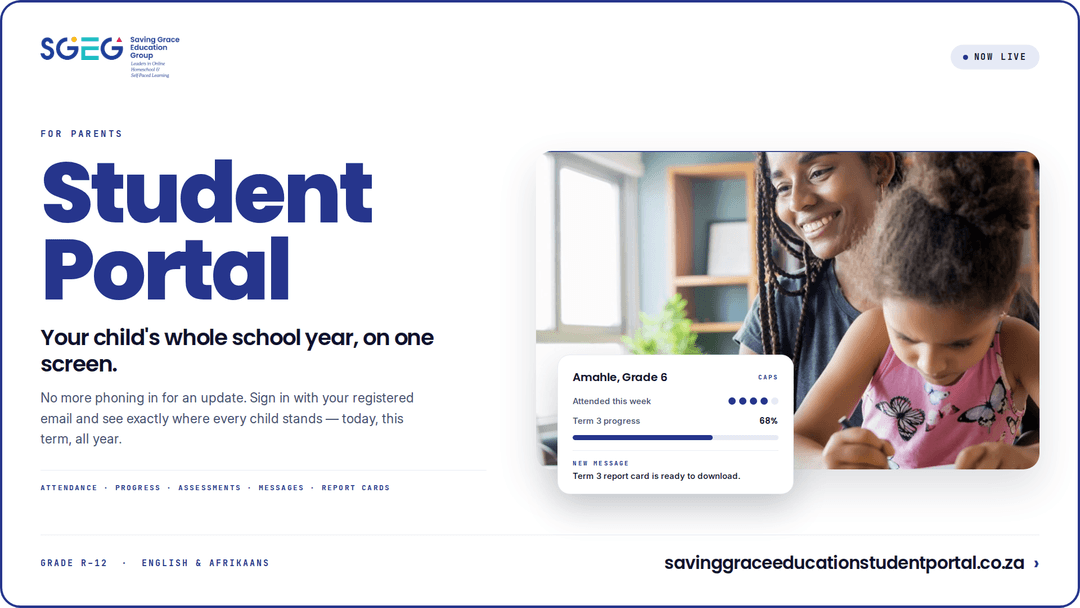
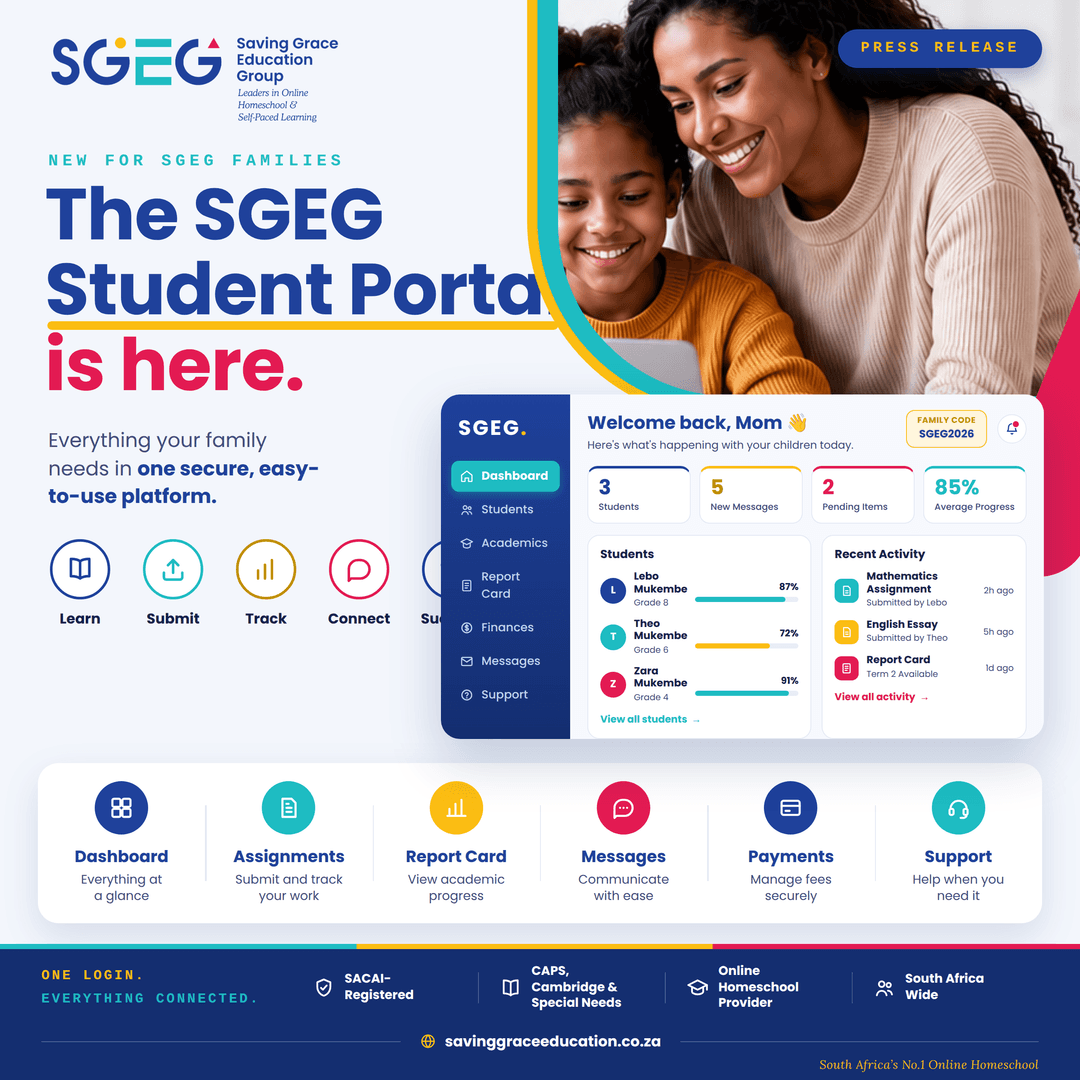
- ✅ Parent progress dashboard — see exactly what your child has completed and where they are excelling
The Parent Dashboard: Because Parents Are the Solution
The 2030 Reading Panel's report is clear: the reading crisis cannot be solved by schools alone. Parents are the most important reading partners a child has — but only if they have the tools and the visibility to play that role.
Every Saving Grace Learn to Read subscription includes a parent progress dashboard — showing which lessons have been completed, which stages have been passed, and where your child is performing well or needs more practice.
You do not need a teaching qualification. You do not need to sit through every lesson. You need five minutes in the evening to check your child's progress, open a conversation about what they learned, and celebrate the certificate they earned this week.
That is the Saving Grace approach. Put the power in the parent's hands.
Accessible to Every South African Family
The most important word in Saving Grace Education Group's approach to the reading crisis is this: affordable.
An innovative solution that only wealthy families can access is not a solution to a national crisis. It is a tool for the already-advantaged.
The Literacy Learner Path is available from R149 per month — less than a family lunch. The first two lessons of every grade are completely free, with no card required to start.
A family in any province, with any level of income, with a smartphone or basic computer, can give their Grade R, 1, 2, or 3 child access to a structured, CAPS-aligned phonics programme — starting today.
👉 Try two free lessons now: www.savinggracelearntoread.co.za
The 2030 Target Is Still Achievable — But Not Without Parents
The 2030 Reading Panel stated plainly: "More needs to be done if we are to ensure that all children learn to read for meaning by 2030."
President Cyril Ramaphosa and the Department of Basic Education have committed to this goal. But Minister of Basic Education Siviwe Gwarube put the responsibility where it ultimately belongs:
"Reading is a foundational skill on which all other learning is built. We must unite to ensure every child has access to books and is afforded the opportunity to achieve their full potential, regardless of their background."
Unite. Not just schools. Not just government. Parents, families, and every stakeholder in a child's life.
The statistics are alarming. The barriers are real. But the solution is clear, the technology exists, and the cost is R149 a month.
If 80% of South African Grade 3 children cannot read for meaning today — the question every parent must ask is: which side of that statistic is my child on?
Start Today — For Free
Your child does not need to be part of the 80%. The Saving Grace Literacy Learner Path gives you the tools to change that — starting with two completely free lessons, no card required.
Grade R | Grade 1 | Grade 2 | Grade 3 | Reading Booster (Grades 4–6)
👉 Start free at: www.savinggracelearntoread.co.za 👉 View plans from R149/month: www.savinggracelearntoread.co.za/subscribe
Not sure which fits your child?
You don't have to decide alone. Ask Grace, or explore the curriculums side by side.